
Misinformation, Disinformation, and Your Secret Weapon in the AI Age

By Dan Drury, Non-executive Director, Bowen Craggs
The digital era has created many new challenges for corporations worldwide, fundamentally altering the dynamics of public perception and trust. As misinformation and disinformation proliferate at an unprecedented pace, now accelerated by artificial intelligence (AI), the integrity of corporate reputations is under constant threat.
Reputation Risk Ahead
This year more voters than ever in history will head to the polls – nearly half of the world’s population will get the chance to vote in national elections. I expect that we will see many examples of misinformation and disinformation being used to influence opinion. The tricks and traps we witness will undoubtedly become AI-powered as politicians, the media, campaigners, activists and bad actors learn to harness the most successful methods to manipulate voters. In particular the ‘floating voters’ that typically decide the result.
In 2008 Barack Obama became the first presidential candidate of a major party to utilize social networking sites to expand and engage his audience of supporters and donors. Obama’s adoption of social media for political campaigning has since been compared to Franklin D. Roosevelt and John F. Kennedy’s adoption of the radio and television media, respectively. In 2021 The European Union said ‘online platforms threaten our societies and democracies’, including through ‘algorithm-fuelled propagation of hate speech and disinformation.’ A 2023 study of Trump’s impeachment found that Twitter ‘bots’ are 66 times more active than normal human users, producing nearly one third of all impeachment-related content, hugely growing Trump’s share of voice. Now there is a danger that TikTok style dopamine-seeking algorithms combined with AI’s power to personalize and impersonate will release legions of smart bots to flood channels eager for more ‘content’. I predict that corporations will be the target of these powerful new techniques once the political frenzy fades, giving communications teams about a year to prepare for a new wave of reputational warfare.
Understanding Misinformation and Disinformation
At the heart of this issue lies the distinction between misinformation—false information spread without malicious intent—and disinformation, which is deliberately designed to deceive. The rapid dissemination capabilities of social media platforms like TikTok, Instagram, and X amplify the reach of such misinformation, often before the truth can take hold. Disinformation, with its insidious nature, further compounds the issue, leveraging the same platforms to undermine trust and distort public perception deliberately.
Social Media has become a Quagmire
Social media, for its part, acts as a double-edged sword, facilitating the spread of information while also serving as a fertile ground for the unchecked proliferation of misinformation and disinformation. The dynamics of sharing and virality on these platforms exacerbate the challenges of identifying and counteracting false information. Negative campaigns, competitor sabotage, self-inflicted viral PR disasters and even employees can inadvertently or intentionally harm your business’s image on social media. All of these can result in losing control of the conversation and the risk of mishandled crisis communications further raises the stakes. Even good news is easily lost in the speed of the feed – your messages are one amongst many in an increasingly fast flowing flood of news.
Furthermore, social media habits are changing. As the major players adjust their algorithms to copycat TikTok’s success (less posts shared by your connections, more posts that you are more likely to enjoy). At the same time users, fearing the backlash from censorship, trolling and legal threats take their conversations into closed communities – sub-groups on messaging platforms, private communities and, increasingly, email lists. This increases the polarity of audiences making it harder for corporations to monitor and join the conversation. This complex landscape demands a nuanced understanding of the forces at play and a strategic response to safeguard and enhance corporate image in 2024 and beyond.
The AI Complication
The role of AI cannot be overstated. Firstly, AI technologies have democratized content creation, enabling the production of sophisticated fake news, images, and videos with chilling realism. This evolution has blurred the lines between truth and fiction, making the source of information a critical determinant of its credibility. As The Economist pointedly noted on January 18, 2024, ‘the technological battle between content generation and detection is increasingly leaning in favor of the forger, making the digital verification of content a Herculean task.’
Secondly, the search landscape will change. AI is already complementing traditional search results and, in time, may end up replacing search behavior for a significant chunk of visitors. You will need to learn how to appear in AI searches and be found in Large Language Models (LLMs) for the topics you want to own and the image you want to project.
Thirdly, you will need to carefully manage your company’s trade secrets, confidential information and internal conversation to ensure they do not end up as sources of data for the AI’s voracious appetite. Most companies have quickly issued AI guidelines and many are trying out ‘walled garden AI’ for employees to use safely.
The Economic Stakes and the Power of Trust
The implications of misinformation and disinformation extend beyond mere reputational damage; they have tangible economic repercussions. Trust, or the lack thereof, can significantly influence investment decisions, employee satisfaction, customer loyalty, regulatory compliance, and risk management. In this vein, Ipsos’ research, «Building reputation in 2023: the link between corporate reputation and business efficiency» reveals a compelling narrative about trust’s pivotal role. Globally, a substantial majority of people are inclined to give companies the benefit of the doubt, a disposition closely tied to their overall trust in the company. Specifically, 51% of those who trust a company «a great deal» are willing to give it the benefit of the doubt in a crisis, compared to a mere 10% among those who feel neutral.
This finding underscores the critical importance of building and maintaining trust as a defensive bulwark against the tide of misinformation and disinformation. Bowen Craggs’ own research (from visitor surveys running on our client’s websites) further illuminates this point, showing that the corporate website can significantly influence public perception, for better or worse.
Visitors neutral towards a company (like the floating voters in politics) are three times more likely to change their perception for the better (27%) vs worse (9%) after visiting the company’s website, emphasizing its role as the ‘owned media’ touchpoint for fact-checking and shaping public opinion.
The table below shows the correlation between ‘pre-visit feeling’ (how visitors feel about the company on arrival at the website) vs. ‘brand perception change’ (how their feelings have been influenced by the end of their visit). It highlights the ability of a good corporate website to reinforce, convert and turnaround your visitor’s perceptions.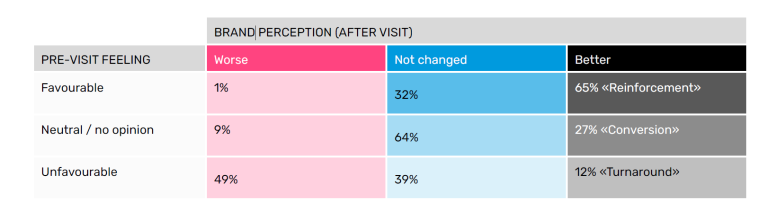
Aggregate data from the Bowen Craggs benchmark survey showing percentages of 306,795 respondents who had their views changed by a website visit. ©Bowen Craggs 2024
Strategic Response and the Path Forward
In response to these challenges, corporations must adopt a multifaceted strategy that encompasses vigilant monitoring, proactive communication, and the strategic use of technology to authenticate content. The corporate website emerges as a critical platform for disseminating accurate information, serving as a beacon of truth in a sea of misinformation.
The findings from Ipsos and Bowen Craggs highlight the indispensable value of trust and perception in the corporate equation. Building and sustaining trust not only shields companies from the adverse effects of misinformation but also enhances their ability to weather crises and maintain positive stakeholder perceptions.
Your Secret Weapon
As we venture deeper into 2024, the corporate struggle against misinformation and disinformation will increasingly hinge on your ability to build and maintain trust. In a landscape where AI and social media have transformed the mechanics of information dissemination, corporations need a secret weapon to protect reputations but also position themselves for sustained economic success in an era where trust is both a precious commodity and a critical strategic asset. The good news – you already have this secret weapon – it’s your corporate website, but is it ready to use?