
The Future of Executive Speech: Merging AI, Culture, and Authenticity

By Petja Georgieva,GlobalCommunicationsforDiagnostics,SiemensHealthineers
Why AI Alone Won’t Win Hearts
Copilot summarises the important emails from last week, while Google Maps offers the best route to the airport. AI is embedded in our daily routine and it’s transforming how we live and work. If it can optimise your commutes and grocery lists, it’s only natural that you look to it to optimise you’re a very critical professional task: communication.
The world is changing faster than ever, driven by technological advancements, like AI, economic changes, political turmoil, or a mix of all. Yet, you are still expected to keep ‘business as usual’ at work and adapt seamlessly. Amid this constant change, staying motivated and focused often requires inspiration and clear guidance. Usually, this is when your leader steps in. Executive speech is what inspires action, conveys vision, motivates for success, and unites around a shared goal. The truly inspiring leaders are the authentic ones who know how to reach all their diverse listeners in a timely manner and with great delivery. Meeting these standards in a fast-paced, global environment is a daunting task for any leader.
The Efficiency Engine
AI is reshaping our ways of working. If you are someone’s manager and you want to step up as their true leader and guide and inspire them, you should be using AI. It is the ultimate brain assistant, which can support you in writing, verifying, and polishing your message fast. This is especially true if you must use a language that isn’t your mother tongue or are constantly on the go with not enough time to prepare properly. Not only that, but you can also practice your message delivery with tools that suggest improvements in your tone of voice and pace. Nowadays, using AI to be more efficient should be an essential part of the process. And while there are thousands of use cases for AI serving you duly, there are also times when you must use your human judgement. Because a powerful executive speech resonates with the audience on a deeper level that goes beyond language.
The Cross-Cultural & Global Challenge
While our brains aren’t as fast and as accurate as machines, they offer something AI still lacks: understanding of context.
Top talent is global – from Kanazawa to Sofia to Dahab – so building an A-team often means hiring internationally. Global teams bring immense advantages – and unique challenges for leaders navigating cultural nuances. Even simple things, like knowing who to greet first, can be so nuanced that even a machine might get them wrong. Indeed, AI would probably know that Brazilians usually do not treat meetings times the same way Americans do, but overgeneralisation often fails. For example, it takes a human logic to estimate that while Anna was born and raised in Milan, she has been working with Germans for over 20 years, so she would know better than showing up late to her work lunch. Understanding your audience well is critical for demonstrating empathy and building genuine connections. Always validate cultural assumptions with direct conversations, not just data.
Authenticity in an Age of Automation
Another human-only aspect where AI falls short is authenticity. Authentic leader is genuine and honest and fosters deep connections with others. This quality shines through both language and body language, and there is no short cut to building it. You need to engage meaningfully with others and build trust.
Unfortunately, AI cannot make you authentic if you aren’t, just as it cannot make you well-travelled or well-read. Only you can do the work.
Authenticity is not optional for a good leader whose job is to motivate hundreds of people. Without it, he/she loses legitimacy; with it, his/her message stands out and is remembered.
Use AI to structure the skeleton of the speech but ensure the ‘bone marrow’—the personal stories and specific values – come directly from you.
New Solutions: Integrating AI, Culture,and Humanity
So, is AI the right tool when writing executive communication? While it cannot be trusted with culturally sensitive topics or matters of authenticity, AI can help you work faster and juggle new ideas. It’s great for proofreading and quick formulation of messages, which are ideal for informing and empowering. It is also very useful when you want to bounce ideas off someone, experiment in a safe environment, and learn new things. Ignoring AI today is like choosing a horse over a car for your commute – possible, but inefficient and costly. Yes, human judgment is irreplaceable Meaningful connections are built by people, not machines. Only humans can interpret underlying intentions, social context, and empathy. And it’s often the failure to do so that breaks communication and relationships.
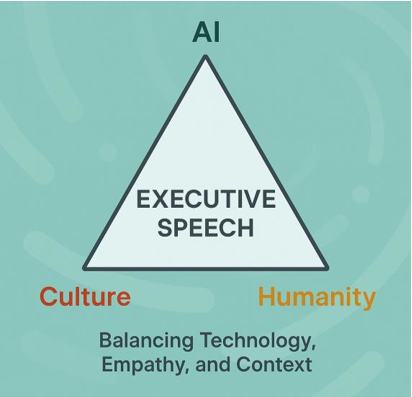
Executive speech triangle
The future of leadership communication isn’t about choosing between AI and humans. It’s about pairing speed with empathy, precision with cultural intelligence, and innovation with authenticity. AI can draft, polish, and accelerate, but only you can inspire, connect, and lead. When technology and humanity work in harmony, your message goes beyond reaching people – it inspires them. That’s the real competitive edge.